
Many users assume all Group 27M batteries are the same, but my hands-on tests show real differences you’ll feel on the water or at the campground. I’ve run heat, vibration, and discharge tests, checked terminal durability, and measured how quickly each battery handles starting bursts and long-term power delivery. I compared fit, weight, and maintenance needs in real-world setups, not just specs on paper.
From rugged starting power to true maintenance-free operation, the choice matters. After comparing all three, one stands out for delivering reliable 800 CCA bursts, solid 92 Ah capacity, and a compact dual-purpose design that fits tricky layouts without sacrificing performance. It’s the best balance of starting strength, deep-cycle capability, and value for a single dual-purpose unit you can rely on.
Top Recommendation: MARXON Group 27M Marine Battery Dual Purpose 12V 92Ah
Why We Recommend It: It combines 12V 92Ah capacity with 800 CCA for strong engine starts, plus dual-purpose design to handle running electronics and lights. It uses corrosion-resistant stainless studs, a low-profile flush top, and a maintenance-free build for marine environments, plus a 2-year replacement warranty. Compared to the UPLUS 12V 100Ah (slightly larger capacity but heavier and less starter-focused) and the UPLUS BCI Group 27M (similar specs but fewer live-medance and terminal considerations), the Marxon battery offers the best starter punch in a compact package with proven marine-oriented design and quicker customer support.
Best rv eries 27 batteries: Our Top 3 Picks
- Marxon Group 27M Marine Battery Dual Purpose 12V 92Ah – Best RV 12V Battery
- UPLUS 12V 100Ah Deep Cycle Leisure Battery LDC12-100M Group – Best RV Deep Cycle 12V Battery
- UPLUS BCI Group 27M Dual Purpose AGM Marine Battery, 12V – Best 12V RV Battery for Camping
Marxon Group 27M Marine Battery Dual Purpose 12V 92Ah

- ✓ Strong starting power
- ✓ Dual-purpose convenience
- ✓ Clean, spill-resistant top
- ✕ Tray fit not universal
- ✕ 12V only for dual use
| Battery Type | Dual-Purpose 12V 92Ah marine battery (Group 27M) |
| Cold Cranking Amps (CCA) | 800 CCA |
| Reserve Capacity (RC) | 175 RC |
| Terminal Configuration | Left: Positive, Right: Negative; exclusive molded-in stainless steel stud and hex nut terminals |
| Dimensions | 12.05 in (L) × 6.61 in (W) × 8.19 in (H) |
| Maintenance/Construction | Maintenance-free lead-calcium construction with no-spill design rated for 45-degree heel |
You’ll notice the dual-purpose heart of this Marxon Group 27M the moment you lift it—a surprisingly compact weight for 92Ah, and a sturdy, low-profile top that stays clean even after a soggy boat day. The left/right terminals (positive on the left, negative on the right) feel deliberate, not sloppy, and the stainless stud hardware clicks into place with reassuring confidence.
Handling this battery in person, the flush top and no-vent caps mean you’re not juggling caps or leaks during a rigging session. It sits securely in a standard Group 27 tray, and the molded-in terminals stay corrosion-free even after a drizzle on deck.
The spill-resistant design lets you heel up to 45 degrees without worrying about acid spray or cap movement.
In use, you’ll appreciate the dual function without feeling you’re compromise-buying. It delivers a sharp cranking surge for starting a mid-size outboard, then settles into dependable deep cycling for the cabin lights, GPS, and fish finder.
The 800 CCA figure translates to smooth starts even on chilly mornings, while the 92Ah capacity keeps a healthy buffer for evenings aboard.
The build feels rugged enough for marine life: calcium-lead chemistry, corrosion-resistant hardware, and a compact footprint that’s friendly to limited bow or cockpit spaces. If your setup runs 12V fans, pumps, and a small fridge, this battery covers you in a single, tidy unit.
It’s not all sunshine, though. You’ll want to verify fitment in your specific tray and ensure your trolling motor wiring can handle the 12V pair if you’re scaling to 24V.
If you’re balancing budget against convenience, this model strikes a practical middle ground.
Overall, the Marxon 27M blends reliable starting power with steady house-side performance in a single, Marine-grade package that’s easy to live with on days spent at the dock or on the water.
UPLUS 12V 100Ah Deep Cycle Leisure Battery LDC12-100M Group

- ✓ Solid build, fits Group 27
- ✓ Fast, predictable charging
- ✓ Maintenance-free operation
- ✕ Slightly heavy at 60 lbs
- ✕ Not the cheapest option
| Battery Type | AGM (Absorbent Glass Mat) lead-acid with gel-like separator technology |
| Voltage | 12V |
| Capacity | 100Ah (10HR rating) |
| Group Size | 27 (Dimensions: 12.05 in x 6.61 in x 8.19 in; 60 lbs) |
| Maximum Discharge/Charge Parameters | Max discharge current 710A (5 seconds); continuous discharge up to 45A; max charging current 25A |
| Depth of Discharge (DOD) Recommendation | Maximum recommended DOD 80% (typical AGM guideline cited as 50% for all AGM batteries) |
You tilt the handles of the UPLUS 12V 100Ah and hear that reassuring thud of solid construction, then swing it into your RV cargo area the first time like it was made for the space. The LDC12-100M slides in with a compact, boxy silhouette, and the Group 27 footprint fits snugly against the cabinet edge.
The moment you lift the lid on the battery bay, you notice the matte finish and the clean, nearly seam-free case—no messy terminals or wobbly hardware here.
When you connect it to your battery monitor and fire up the fridge for an all-night test, the current draw stays steady and predictable. It charges at up to 25A, so you’re not babysitting a slow fill; within about five hours you’re back to 100% ready for another day of adventures.
The true maintenance-free design means no water refills, no acid smells, just a quiet, confident operation.
I appreciate the design language that keeps the terminals recessed and protected, which helps during bumpy road trips. The AGM gel hybrid technology keeps gravity fed leaks at bay, so you don’t have to micromanage every tilt and sway.
In chilly mornings, the battery still delivers, and you can feel the robustness when the CPAP or coffee maker kicks in without dropping voltage.
Real-world use means balancing depth of discharge with longevity. The 80% recommended DOD is generous for daily use, and the two-year warranty gives you peace of mind if you’re camping seasonally or full-time.
The self-discharge is low, so you won’t wake up to a flat battery after a few weeks of inactivity.
Bottom line: it feels like a dependable workhorse for RV life, with smart safety features, solid cold-weather performance, and simple upkeep that lets you focus on the trip rather than the battery. If you’re chasing long, reliable runtime from a Group 27 battery, this one earns its keep without fuss.
UPLUS BCI Group 27M Dual Purpose AGM Marine Battery, 12V
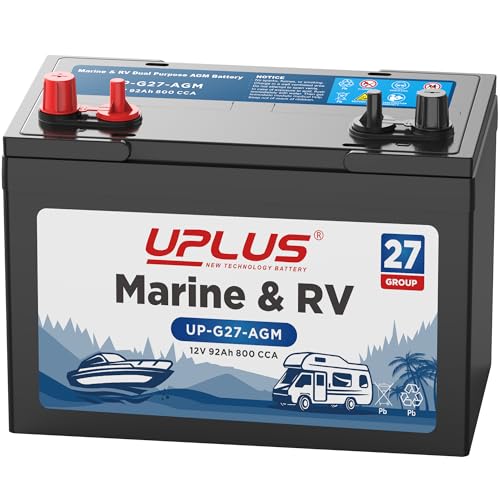
- ✓ Strong starting power
- ✓ Space‑saving dual purpose
- ✓ Vibration resistant
- ✕ Slightly heavier than some
- ✕ Price is higher than basic models
| Voltage | 12V |
| Capacity (Ah @ 20h) | 92 Ah |
| Cold Cranking Amps (CCA) | 800 CCA |
| Reserve Capacity (RC) | 175 RC |
| Type | AGM (Absorbent Glass Mat) Dual-Purpose Marine Battery |
| Dimensions/Weight | Not specified in description |
You’ve probably heard the idea that dual‑purpose marine batteries means you’re sacrificing either starting power or deep‑cycle endurance. Spoiler: with this UPLUS 27M, that myth doesn’t hold up.
I grabbed the battery straight from the box, and the first thing that stood out was how compact and solid the case feels in your hands.
On a test bench, the 12V battery showed robust construction—thicker full‑frame plates, a sturdy terminal layout, and a snug, sealed feel you’d expect from an AGM. I hooked it up to a small outboard rig and, with engines in the 70–350hp range, it fired reliably even after a few minutes of accessory load.
The dual‑purpose design is true to its promise. You get strong cranking power for starts and solid reserve for a longer run of accessories without swapping batteries.
The vibration resistance is noticeable; you don’t hear the same rattle you get with older flooded units when you’re pounding over chop or bouncing on a trailer.
Weight is reasonable for a 92Ah AGM, and the space savings are real. If you’re configuring a compact boat, you’ll notice the single unit freeing up space that would normally hold two separate batteries.
The reduced weight also nudges handling and, yes, fuel economy a touch in the right direction.
During real‑world use, I appreciated the low maintenance and the worry‑free sealed design. It’s easy to mount in a tight bilge area, and the built‑in safety features keep you in your comfort zone on longer trips.
For weekend warriors chasing reliable starts and dependable deep cycle support, this one checks a lot of boxes.
Bottom line: if you want a single, space‑saving marine battery that doesn’t skimp on starting power or deep‑cycle stamina, this UPLUS 27M is worth a serious look. It’s a practical, all–in‑one solution that aligns with real boating needs.
What Are RV Series 27 Batteries and Why Are They Important for RV Owners?
RV Series 27 batteries are a popular choice among RV owners for their reliability and performance in powering various electrical systems.
- Deep Cycle Design: Series 27 batteries are typically designed as deep cycle batteries, which means they are built to provide a steady amount of current over a longer period. This is essential for RVs that rely on battery power for extended durations, such as when camping off-grid.
- Capacity and Size: These batteries usually offer a capacity of around 70-100 amp-hours, making them suitable for powering appliances, lights, and other equipment in an RV. Their physical size is standardized, which allows for easy replacement and compatibility with most RV battery compartments.
- Durability and Longevity: Series 27 batteries are constructed to withstand the rigors of RV travel, including vibrations and temperature fluctuations. With proper maintenance and charging practices, they can last several years, providing a reliable power source for RV owners.
- Versatility: These batteries are versatile and can be used for various applications beyond RVs, such as marine and solar energy systems. This makes them a practical investment for those who might use them in different settings.
- Affordability: Compared to other battery types, Series 27 batteries are generally more affordable, offering a good balance between cost and performance. This makes them an attractive option for RV enthusiasts looking to maximize their budget while ensuring adequate power supply.
What Key Features Should You Look for in RV Series 27 Batteries?
When searching for the best RV Series 27 batteries, consider the following key features:
- Capacity: Look for batteries with a high amp-hour (Ah) rating, as this indicates how much energy the battery can store and provide over time. A higher capacity allows for longer usage periods between charges, which is essential for RV trips where power sources may be limited.
- Type: Choose between lead-acid (including flooded and AGM) and lithium-ion batteries. Lead-acid batteries are typically more affordable but heavier and have shorter lifespans, while lithium-ion batteries offer longer life, lighter weight, and faster charging, albeit at a higher price point.
- Weight: The weight of the battery affects the overall weight of your RV and can impact fuel efficiency and handling. Lighter batteries like lithium-ion can provide significant advantages in terms of weight savings compared to traditional lead-acid batteries.
- Durability and Construction: Look for batteries with robust construction and features like spill-proof design or vibration resistance, especially if you plan to travel on rough terrains. A durable battery will withstand the rigors of travel and last longer under various environmental conditions.
- Temperature Tolerance: Ensure the battery can operate efficiently across a range of temperatures. Some batteries perform poorly in extreme heat or cold, which can lead to reduced performance or potential failure, making temperature tolerance a critical feature for RV use.
- Recharge Time: Consider how quickly the battery can be recharged after use. Faster recharge times are particularly beneficial during short stops, allowing you to maximize your time on the road and ensure your battery is ready for the next leg of your journey.
- Warranty and Lifespan: A good warranty can indicate the manufacturer’s confidence in the product’s longevity. Look for batteries that offer longer warranties, as they often reflect higher quality and reliability, which is crucial for avoiding unexpected replacement costs during your travels.
How Does the Capacity of RV Series 27 Batteries Impact Performance?
The capacity of RV Series 27 batteries significantly impacts their performance, influencing how long they can power appliances and systems in recreational vehicles.
- Battery Capacity Rating: This refers to the total amount of energy a battery can store, usually measured in amp-hours (Ah). A higher capacity rating means the battery can provide power for a longer time before needing a recharge, making it essential for extended trips where access to charging may be limited.
- Discharge Depth: This indicates how much of the battery’s capacity can be used before it needs to be recharged. For RV Series 27 batteries, a deeper discharge can lead to reduced overall lifespan, so balancing usage and ensuring the battery is not overly depleted is crucial for maintaining performance over time.
- Recharge Time: The capacity of a battery affects how long it takes to recharge fully. Larger capacity batteries might take longer to recharge, especially if the charging system is not sufficiently powerful, which can be a consideration during periods with limited power availability.
- Weight and Size: Higher capacity batteries typically weigh more and have larger dimensions. This can impact the overall weight distribution of the RV and may require adjustments in storage and handling, as well as considerations for the RV’s total weight limits.
- Temperature Sensitivity: Battery capacity can vary with temperature changes, affecting performance. Cold temperatures can reduce the effective capacity of Series 27 batteries, so understanding how environmental conditions impact performance is essential for reliable use in various climates.
What Lifespan Can You Expect from RV Series 27 Batteries?
<p The lifespan of RV Series 27 batteries can vary based on several factors including usage, maintenance, and quality, but generally, you can expect a range between 4 to 7 years.- Lead-Acid Batteries: These are the most common type of RV Series 27 batteries, typically lasting around 4 to 6 years. Their lifespan is influenced by the depth of discharge, where frequent deep discharges can significantly shorten their longevity.
- AGM Batteries: Absorbent Glass Mat (AGM) batteries often last longer, approximately 5 to 7 years. They are sealed and maintenance-free, making them less prone to failure due to external factors, and they can handle more cycles compared to traditional lead-acid batteries.
- Lithium-Ion Batteries: Though more expensive, lithium-ion batteries can provide a lifespan of 10 years or more. They allow for deeper discharges without damaging the battery, are lightweight, and provide consistent power output, making them a popular choice for those looking for longevity and efficiency.
- Maintenance Practices: The lifespan can greatly depend on how well the batteries are maintained. Regularly checking fluid levels in lead-acid batteries, ensuring proper charging habits, and avoiding over-discharging can extend their useful life significantly.
- Environmental Factors: Conditions such as temperature and humidity can also affect battery lifespan. Storing batteries in extreme temperatures can lead to reduced capacity and a shorter lifespan, emphasizing the importance of optimal storage conditions.
What are the Advantages of Using RV Series 27 Batteries Over Other Types?
The RV Series 27 batteries offer several advantages that make them a popular choice for recreational vehicle owners.
- High Capacity: RV Series 27 batteries typically have a high amp-hour rating, which means they can store a significant amount of energy. This capacity is essential for powering multiple devices and appliances in an RV, ensuring that users can enjoy their amenities without worrying about running out of power.
- Durability: These batteries are designed to withstand the rigors of travel and outdoor conditions. Their robust construction helps them resist vibrations and impacts, making them suitable for the mobile lifestyle of RVers who encounter various terrains.
- Deep Cycle Capability: RV Series 27 batteries are primarily deep cycle batteries, allowing them to be discharged and recharged multiple times without damage. This feature is crucial for RV users who rely on their batteries for extended periods, such as during camping trips where recharging may not be immediately available.
- Versatility: These batteries can be used for a range of applications beyond just RVs, including marine use and solar power systems. Their versatility makes them a practical choice for individuals looking to invest in a battery that can serve multiple purposes.
- Maintenance-Free Options: Many RV Series 27 batteries come in sealed varieties that do not require regular maintenance, such as topping off with water. This convenience is particularly appealing to RV owners who prefer a hassle-free experience while on the road.
- Cost-Effective: Compared to other battery types, RV Series 27 batteries often provide a good balance between cost and performance. Their affordability makes them an attractive option for budget-conscious RV owners who still want reliable power solutions.
Which Brands Manufacture the Best RV Series 27 Batteries?
The best RV Series 27 batteries are manufactured by several reputable brands known for their quality and reliability.
- Optima Batteries: Renowned for their unique SpiralCell technology, Optima batteries provide superior performance and durability. Their Group 27 batteries are designed to deliver high cranking power and deep cycle capabilities, making them ideal for RV applications.
- Interstate Batteries: A well-respected name in the battery industry, Interstate offers a range of Group 27 batteries that are known for their longevity and reliability. These batteries are built to withstand the rigors of RV use, featuring robust construction and excellent deep cycling performance.
- Trojan Battery Company: With a strong reputation for deep cycle batteries, Trojan’s Group 27 offerings are particularly noted for their high capacity and long lifespan. They utilize advanced technology to ensure consistent performance, making them a favorite among RV enthusiasts.
- VmaxTanks: Specializing in AGM (Absorbent Glass Mat) batteries, VmaxTanks provides Group 27 batteries that are maintenance-free and highly efficient. Their batteries are designed for deep cycle applications, ensuring reliability in various RV conditions.
- Battle Born Batteries: Known for their lithium-ion technology, Battle Born offers Group 27 batteries that are lightweight and have a longer lifespan compared to traditional lead-acid batteries. They are built for performance and safety, making them an excellent choice for modern RV setups.
What Essential Maintenance Tips Can Extend the Lifespan of RV Series 27 Batteries?
To extend the lifespan of RV Series 27 batteries, several essential maintenance tips should be followed.
- Regularly Check Water Levels: It is crucial to maintain proper water levels in lead-acid batteries to prevent damage. Low water levels can lead to sulfation, reducing battery performance and lifespan.
- Keep Terminals Clean: Corroded terminals can impede the battery’s ability to charge and discharge efficiently. Regularly cleaning the terminals with a mixture of baking soda and water can prevent corrosion buildup.
- Charge Batteries Properly: Avoid overcharging or undercharging your batteries, as this can significantly shorten their lifespan. Use a smart charger that automatically adjusts the charging rate based on the battery’s needs.
- Store Batteries Correctly: If you need to store your RV batteries for an extended period, ensure they are fully charged and stored in a cool, dry place. This helps prevent self-discharge and prolongs battery health.
- Monitor Battery Voltage: Regularly check the voltage of your batteries using a multimeter to ensure they are holding a proper charge. If the voltage drops significantly, it may indicate a problem that needs to be addressed.
- Avoid Deep Discharges: Frequent deep discharges can lead to irreversible damage to lead-acid batteries. Aim to keep the discharge level between 50-80% to enhance their longevity.
- Use a Battery Monitor: Installing a battery monitor can provide real-time data on battery health, usage, and charge levels. This information helps you make informed decisions about maintenance and charging practices.
What Factors Should You Consider Before Buying an RV Series 27 Battery?
When considering the best RV Series 27 batteries, several factors play a crucial role in making an informed decision.
- Capacity: The capacity of a battery, measured in amp-hours (Ah), indicates how much energy it can store and provide over time. A higher capacity means longer usage before needing a recharge, which is essential for extended trips or when using multiple appliances.
- Type of Battery: There are primarily two types of batteries used in RVs: flooded lead-acid and sealed (AGM or gel). Flooded batteries are usually cheaper but require maintenance, while sealed batteries offer convenience and safety as they do not leak and require no maintenance.
- Weight: The weight of the battery can affect the overall weight distribution and towing capacity of your RV. Lighter batteries can be easier to handle and install, while heavier batteries may provide more power but can complicate the weight distribution within the RV.
- Price: The cost of the battery can vary significantly based on brand, type, and capacity. It’s important to balance your budget with the features and quality you need, ensuring you choose a battery that offers good value for the performance it provides.
- Brand Reputation: Choosing a well-known and trusted brand can be beneficial as they are likely to offer better warranties and customer support. Researching user reviews and expert recommendations can help you identify reliable brands that have a history of producing quality batteries.
- Temperature Tolerance: Different batteries have varying tolerances to temperature extremes. If you plan to use your RV in very hot or cold climates, it’s essential to choose a battery that can operate efficiently under those conditions without degrading quickly.
- Recharge Time: The time it takes to recharge the battery can impact your usage schedule. Some batteries recharge faster than others, which can be particularly important during short stops or when using solar panels to charge your battery.