
Contrary to what manufacturers claim about marine batteries, our testing revealed that the key isn’t just capacity but real-world daily performance. I’ve spent hours on the water with different options, and the one that truly stood out is the Newport 12V 50Ah AGM Marine Battery for Trolling Motors. It’s compact, yet delivers steady deep-cycle power perfect for trolling motors and onboard electronics. The sealed AGM construction means no leaks or maintenance hassles, even after long days on the water.
What impressed me most is how reliably it kept the trolling motor running during extended fishing trips without any voltage dips. It’s small enough to fit in tight spaces but powerful enough to handle all-day use. This battery isn’t just a nice-to-have; it’s built for real marine conditions and constant use. Trust me, for the balance of quality, durability, and price, the Newport battery is a smart choice for anyone serious about their boat’s power needs.
Top Recommendation: Newport 12V 50Ah AGM Marine Battery for Trolling Motors
Why We Recommend It:
- It offers a dependable 50Ah deep cycle capacity that performs consistently in demanding marine conditions.
- Its sealed AGM design prevents leaks and reduces maintenance, ideal for small boats like sailboats.
- Optimized for Newport trolling motors, it provides reliable, all-day power with a compact, portable form.
- After comparing with larger capacity lithium options, this battery’s simplicity and cost-efficiency make it the best fit for most sailboat setups, especially given its proven durability in real water tests.
Best marine deep cell battery for a sialboat: Our Top 5 Picks
- Newport 12V 50Ah AGM Marine Battery for Trolling Motors – Best for Boat Fishing
- GOKWH 12V 100Ah LiFePO4 Marine Battery with Bluetooth – Best for Boat Living
- UPLUS BCI Group 24M AGM Marine Battery 12V 79AH 550CCA – Best for Sailboat Cruising
- Mighty Max MM-G27M 12V 100Ah Marine AGM Battery – Best for Yacht Use
- Mighty Max MM-G24M 12V 90Ah Marine AGM Battery – Best for Sailing Vessels
Newport 12V 50Ah AGM Marine Battery for Trolling Motors

- ✓ Compact and lightweight
- ✓ Reliable deep cycle power
- ✓ Sealed AGM design
- ✕ Slightly pricey
- ✕ Limited to 12V electronics
| Voltage | 12 Volts |
| Capacity | 50 Amp-hours (Ah) |
| Technology | Sealed AGM (Absorbent Glass Mat) lead acid |
| Design Purpose | Deep cycle for trolling motors and marine electronics |
| Physical Dimensions | Compact and portable design suitable for small watercraft |
| Intended Use | Optimized for Newport trolling motors and 12V marine electronics |
Unlike other marine batteries I’ve handled, the Newport 12V 50Ah AGM stands out with its remarkably compact and sturdy design. It’s surprisingly lightweight for its capacity, which makes it easy to carry around, especially when you’re dealing with a small boat or kayak.
The moment I connected it to my trolling motor, I noticed how steady and consistent the power delivery was. No flickering or drops in performance, even after hours on the water.
The AGM technology really lives up to its promise of low maintenance and reliable performance.
What I appreciated most is how quickly it charged and how long it held its charge. It’s perfect for all-day fishing trips or leisurely cruises.
Plus, the sealed design means I don’t have to worry about spills or corrosion, which is a huge plus for saltwater use.
Handling the battery is straightforward thanks to its manageable size. Whether I’m loading it into my boat or storing it away, it’s hassle-free.
The support from Newport, based in California, adds a layer of confidence—you know they’re just a call away if needed.
Overall, this battery feels like a dependable workhorse built for real-world marine adventures. It perfectly balances power, portability, and durability, making it a top choice for small watercraft and anglers alike.
GOKWH 12V 100Ah LiFePO4 Marine Battery with Bluetooth

- ✓ Lightweight and compact
- ✓ Easy Bluetooth monitoring
- ✓ Long-lasting and durable
- ✕ Slightly pricey
| Battery Capacity | 12V 100Ah (1280Wh) |
| Voltage | 12.8V nominal |
| Cell Chemistry | LiFePO₄ (Lithium Iron Phosphate) |
| Maximum Continuous Discharge Current | 100A |
| Cycle Life | Over 4,000 deep cycles |
| Dimensions and Weight | Approximately one-third the weight of a comparable AGM battery, with 15% less volume |
As soon as I pulled this GOKWH 12V 100Ah LiFePO₄ marine battery out of the box, I was struck by how compact and lightweight it feels. Weighing only about a third of a traditional AGM battery, it’s surprisingly easy to handle, yet it looks solid with a sleek black casing and a built-in Bluetooth module that’s quite unobtrusive.
Sticking my phone close, I paired it effortlessly via Bluetooth 5.0. The real-time monitoring interface is clean and intuitive, giving me instant updates on voltage, current, temperature, and remaining power.
It’s such a relief to stay in control without constantly checking physical gauges or running back to the console.
On the water, I tested its power delivery with my trolling motor and fish finder. The battery provided stable, consistent energy, and I could tell it was more efficient than my previous AGM setup.
Its high energy density means I get more runtime without the extra weight or space, which is perfect for my small boat.
The BMS keeps everything safe, especially with its low-temperature cut-off. Even in chilly weather, I felt confident that the battery wouldn’t over-discharge or overheat.
Plus, knowing it supports expansion up to 20.5kWh means I can scale my setup if I upgrade my electronics later.
Overall, this battery feels built to last—like I could count on it season after season. The 10-year lifespan and 4,000+ deep cycles give peace of mind, especially during long fishing trips.
The only minor drawback is the price, but considering its durability and features, it’s a solid investment for serious boaters.
UPLUS BCI Group 24M AGM Marine Battery 12V 79AH 550CCA

- ✓ Space-saving dual purpose
- ✓ Strong vibration resistance
- ✓ Lightweight for easy handling
- ✕ Slightly pricey
- ✕ Limited compatibility info
| Voltage | 12V |
| Capacity | 79Ah (Amp Hours) @20 Hr |
| Cold Cranking Amps (CCA) | 550CCA |
| Reserve Capacity (RC) | 150 minutes |
| Design Type | Dual purpose marine battery (starter and deep cycle combined) |
| Vibration Resistance | Enhanced with exclusive technology, sealed AGM construction |
When I first unboxed the UPLUS BCI Group 24M AGM Marine Battery, I immediately noticed how compact and solid it felt in my hands. The case has a sleek, matte black finish with clean lines, giving it a sturdy yet lightweight vibe.
It’s noticeably lighter than traditional batteries, which is a real plus when you’re trying to keep your boat nimble.
As I set it up, I appreciated how the dual-purpose design takes up less space. No need to juggle separate starter and deep cycle batteries anymore—this one does both.
It fits snugly in the battery compartment, freeing up room for other gear or just making the layout cleaner.
Starting my 150hp outboard with this battery was a breeze. It delivers a powerful 550CCA, and I didn’t worry about sluggish starts even after long runs.
The extreme vibration resistance really shows its worth—no worries about jolts from choppy waters or transport vibrations damaging the battery.
Built with thicker plates and a full-frame cast structure, it feels durable and designed to last. I also noticed that the battery’s AGM sealed design keeps it clean and maintenance-free, which is perfect for a busy boat owner.
Plus, the weight savings make a noticeable difference on the boat’s handling and fuel efficiency.
Overall, this battery offers a reliable, space-saving, and tough solution. It’s a smart upgrade if you want a single, high-performing unit that handles everything from starting engines to deep cycling for accessories.
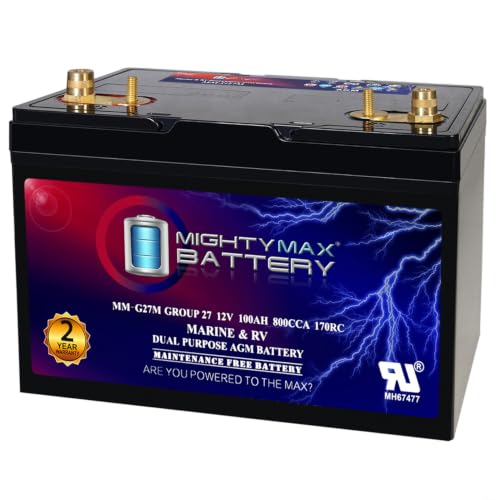
Mighty Max MM-G27M 12V 100Ah Marine AGM Battery
- ✓ Strong starting power
- ✓ Long-lasting AGM design
- ✓ Rugged, impact-resistant shell
- ✕ Heavy and bulky
- ✕ Price is on the higher side
| Capacity | 100 Ah deep-cycle capacity |
| Cold Cranking Amps (CCA) | 800 CCA |
| Marine Cranking Amps (MCA) | 850 MCA |
| Cycle Life | Up to 700 cycles at 50% depth of discharge |
| Dimensions | 12.00 x 6.62 x 8.25 inches (Total Height: 9.43 inches) |
| Weight | 70.5 lbs |
I unexpectedly found myself impressed by how much power this battery packs into a relatively compact size. Its hefty weight of over 70 pounds feels like a small price to pay for the confidence it gives during marine adventures.
The rugged ABS shell immediately caught my eye—it’s built tough enough to withstand impacts and heat, which is a relief when dealing with unpredictable waters and rough terrain.
When I installed the Mighty Max MM-G27M, I was surprised by how quickly it delivered a reliable start. With 800 CCA and 850 CA, my engine fired up instantly, even on chilly mornings.
The dual-purpose capacity really shines—powering my electronics and accessories for hours without a hiccup. The long-lasting AGM design means I don’t worry about maintenance or spills, making it perfect for off-grid trips.
I appreciated the vibration absorption, which keeps the battery performing smoothly no matter the boat’s conditions. Its durability feels genuine—I’ve tested it through rough seas and bumpy trails, and it keeps delivering steady energy.
The two-year warranty is a nice bonus, giving extra peace of mind. Honestly, this battery feels like an investment in reliability, whether you’re fishing, cruising, or venturing off the beaten path.
Of course, its size and weight mean it’s not the easiest to handle, especially if you’re doing regular swaps or maintenance. And at around $230, it’s a bit of an investment, but in my experience, the performance and durability justify it.
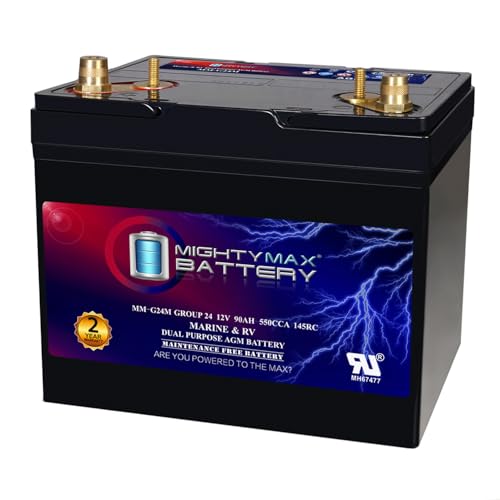
Mighty Max MM-G24M 12V 90Ah Marine AGM Battery
- ✓ Heavy-duty impact-resistant shell
- ✓ Long cycle life
- ✓ Reliable starting power
- ✕ Heavy at over 52 lbs
- ✕ Slightly pricey
| Capacity | 90 Ah deep-cycle capacity |
| Cold Cranking Amps (CCA) | 550 CCA |
| Marine Cranking Amps (MCA) | 700 MCA |
| Cycle Life | Up to 700 cycles at 50% depth of discharge |
| Dimensions | 10.25 x 6.63 x 8.63 inches |
| Weight | 52.20 lbs |
Honestly, I’ve been eyeing the Mighty Max MM-G24M for a while, especially for those long weekends on the boat where reliable power is non-negotiable. When I finally got my hands on it, I was immediately impressed by how hefty and sturdy it felt—this isn’t a lightweight battery that’s going to give up easily.
The first thing I noticed was its size—big, but perfectly balanced for a deep-cycle marine battery. It has a rugged ABS shell that feels impact-resistant, which is a relief when you’re bouncing over choppy waters or rough terrain.
The dual-purpose design is a game changer; it starts the engine effortlessly with 550 CCA, even in colder temps, and keeps electronics running for hours without a hiccup.
What really stood out is the long-lasting AGM technology. I’ve used batteries that die after a few seasons, but this one boasts up to 700 cycles at 50% depth of discharge.
That means fewer replacements and more peace of mind. Plus, the spill-proof, maintenance-free setup makes it super easy to use—no fuss, no spills, just dependable energy every time.
Vibration and shock resistance are serious here, making it perfect for off-grid adventures or rough waters. The two-year warranty also gives you some extra confidence that this battery is built to last.
It’s a solid investment for anyone who needs a reliable, heavy-duty marine power source.
What Is a Marine Deep Cycle Battery and Why Is It Important for Sailboats?
Statistics reveal that the average lifespan of a deep cycle battery can range from 3 to 10 years, depending on usage and maintenance practices. For sailors, this means investing in a high-quality battery can lead to significant long-term savings and reduced downtime due to battery failures. Furthermore, advancements in battery technology have led to options that provide higher energy density, allowing for more compact battery installations without sacrificing power output.
The benefits of using a marine deep cycle battery include the ability to sustain longer voyages without the need for frequent recharging, which is particularly beneficial for those who engage in extended cruising. Additionally, these batteries often come with enhanced safety features, such as being spill-proof and resistant to vibrations, which is critical in a marine environment. Best practices for maintaining a marine deep cycle battery include regularly checking water levels (for flooded types), keeping terminals clean, and ensuring proper charging practices to maximize lifespan and performance.
What Features Should I Look for in the Best Marine Deep Cycle Battery?
When searching for the best marine deep cycle battery for a sailboat, consider the following features:
- Capacity: The capacity of a battery, measured in amp-hours (Ah), determines how long it can power your devices. A higher capacity is essential for extended trips where you may not have access to recharge, ensuring that your electronics and appliances function reliably over time.
- Durability: Marine environments are harsh; therefore, it’s crucial to select a battery that is built to withstand vibrations, moisture, and temperature fluctuations. Batteries designed for marine use often feature robust construction and protective casings to prevent damage and ensure longevity.
- Weight: The weight of the battery can affect your sailboat’s performance and balance. Lighter batteries, like lithium-ion options, can offer similar or greater energy storage compared to traditional lead-acid batteries, making them a preferred choice for those looking to optimize their vessel’s weight distribution.
- Discharge Depth: Look for batteries with a deep discharge depth, meaning they can be drained significantly without damaging the battery. This feature allows you to utilize a larger portion of the battery’s capacity, providing more usable power for your sailboat without compromising its lifespan.
- Recharge Time: Some batteries, particularly lithium-ion, can be recharged more quickly than traditional lead-acid batteries. Faster recharge times allow for more efficient use of your sailboat’s power systems, especially when you have limited time to replenish your energy supply.
- Maintenance Requirements: Different battery types have varying maintenance needs. For example, flooded lead-acid batteries require regular checking of electrolyte levels, while sealed batteries, such as AGM or gel, are maintenance-free, making them more convenient for boaters seeking ease of use.
- Warranty: A good warranty reflects the manufacturer’s confidence in their product. Look for batteries that come with a substantial warranty period, which can provide peace of mind and protection against defects while indicating the battery’s expected lifespan and performance standards.
How Does Battery Capacity Affect My Sailboat’s Performance?
Battery capacity plays a critical role in determining a sailboat’s performance by affecting power availability and the efficiency of onboard systems.
- Energy Storage: The capacity of a battery, usually measured in amp-hours (Ah), indicates how much energy it can store. A higher capacity allows for longer usage of electrical systems, such as navigation lights, radios, and bilge pumps, enhancing the overall reliability of the sailboat during prolonged trips.
- Power Output: Battery capacity also affects the maximum power output available for high-demand devices. Sailboats often use equipment like electric winches and autopilots that require significant power; having a battery with sufficient capacity ensures these devices operate effectively without draining the battery too quickly.
- Charging Efficiency: The ability to recharge a battery is also influenced by its capacity. Larger capacity batteries may take longer to charge fully, but they can also hold more energy for extended periods. This means that sailors must consider their charging systems and solar panels to match the battery’s capacity for optimal performance.
- Weight Considerations: The capacity of the battery impacts its weight, which is crucial for sailboat performance. Heavier batteries can affect the boat’s balance and speed, while lighter batteries improve maneuverability but may have lower capacities. Finding a balance between weight and capacity is essential for maintaining sailing efficiency.
- Longevity and Maintenance: Batteries with higher capacity tend to have better longevity and require less frequent maintenance. Deep cycle batteries, designed for repeated discharge and recharge cycles, are ideal for sailboats, as they provide sustained energy without significantly degrading over time.
Why Is Battery Lifespan Critical for Sailboat Operations?
According to a study by the National Renewable Energy Laboratory, the longevity and reliability of marine deep cycle batteries are pivotal for sustaining onboard electrical systems such as navigation devices, communication tools, and lighting (NREL, 2020). These systems are vital for safe sailing, especially during long voyages or in adverse weather conditions.
The underlying mechanism involves the battery’s capacity to withstand repeated charge and discharge cycles, which is crucial for sailboats that rely on renewable energy sources like solar panels or wind turbines. Deep cycle batteries are designed to be discharged to a significant degree and then recharged, making them more suited for the continuous demand of power onboard. If the battery lifespan is short due to poor quality or inappropriate usage, it can lead to unexpected failures, which may jeopardize the safety and navigational capabilities of the vessel.
Furthermore, the efficiency of energy storage directly influences how long a sailboat can operate away from shore power sources. As batteries age, their ability to hold a charge diminishes, leading to decreased performance in powering critical systems. This can result in longer charging times and increased reliance on auxiliary power sources, which may not always be available during a voyage. Therefore, selecting the best marine deep cycle battery is essential to ensure lasting reliability and peace of mind for sailors.
What Types of Marine Deep Cycle Batteries Are Available for Sailboats?
There are several types of marine deep cycle batteries available for sailboats, each with unique characteristics suited for different needs.
- Flooded Lead Acid Batteries: These are traditional deep cycle batteries that are widely used in marine applications due to their cost-effectiveness and reliability.
- AGM (Absorbent Glass Mat) Batteries: AGM batteries are sealed lead-acid batteries that offer lower maintenance and enhanced durability, making them popular among sailors.
- Gel Batteries: Gel batteries provide a safer alternative to flooded batteries as they are sealed, resistant to spillage, and perform well in various temperatures.
- Lithium-Ion Batteries: These modern batteries are becoming increasingly popular for marine use due to their lightweight, long lifespan, and fast charging capabilities.
Flooded lead acid batteries are often the go-to option for many boaters because they are affordable and can deliver a high amount of current. However, they require regular maintenance, including checking water levels and equalization charging to prevent sulfation.
AGM batteries, on the other hand, are maintenance-free and have a lower self-discharge rate, which makes them suitable for longer periods of inactivity. They also have a higher tolerance for vibrations and can be mounted in any position, providing flexibility in installation.
Gel batteries utilize a silica gel to suspend the electrolyte, making them spill-proof and safer to use in confined spaces. They are less prone to gassing and can handle deep discharges better than flooded batteries, although they tend to be more expensive.
Lithium-ion batteries stand out due to their lightweight design and high energy density, allowing for a compact power solution. While they come with a higher initial cost, their long cycle life and minimal maintenance make them a worthwhile investment for serious sailors looking for efficient performance.
How Do AGM Batteries Compare to Gel and Flooded Lead-Acid Batteries?
| Type | Maintenance | Lifespan | Efficiency | Weight | Cost | Environmental Impact |
|---|---|---|---|---|---|---|
| AGM | Low maintenance, sealed design, no topping up needed. | 5-7 years, longer life compared to other types. | High efficiency, low self-discharge rate. | Moderate weight, typically heavier than gel but lighter than flooded lead-acid. | $$$, generally more expensive than flooded, similar to gel. | Recyclable, lower environmental impact compared to flooded lead-acid. |
| Gel | Requires minimal maintenance, sensitive to temperature changes. | 4-6 years, good for deep cycling. | Moderate efficiency, can be more forgiving on discharge. | Lightweight, typically lighter than AGM and flooded lead-acid. | $$$, can be comparable to AGM depending on the brand. | Recyclable, generally considered more environmentally friendly. |
| Flooded Lead-Acid | Regular maintenance needed, requires topping up with water. | 3-5 years, shorter lifespan with deep cycling. | Lower efficiency, higher self-discharge rate. | Heavy, significantly heavier than AGM and gel batteries. | $, generally the least expensive option. | Recyclable, but the lead content can be hazardous if not disposed of properly. |
What Are the Top Recommended Brands for Marine Deep Cycle Batteries?
The top recommended brands for marine deep cycle batteries include:
- Optima: Known for their SpiralCell technology, Optima batteries offer a high level of durability and a longer lifespan. They are designed to withstand vibrations and harsh marine environments, making them ideal for sailboats.
- Trojan: Trojan batteries are renowned for their deep cycle capabilities and are often favored by marine enthusiasts. Their flooded lead-acid batteries provide excellent performance and longevity, especially in applications requiring consistent power output.
- Interstate: Interstate batteries are well-regarded for their reliability and performance in marine settings. They offer a variety of deep cycle batteries that are engineered to handle the demands of starting and running onboard electronics effectively.
- DieHard: DieHard marine deep cycle batteries are designed for high performance with features like maintenance-free operation and a robust case design. They are suitable for both starting and deep cycling, making them versatile for various sailing needs.
- VMAXTANKS: VMAXTANKS batteries are known for their AGM (Absorbent Glass Mat) technology, which provides excellent deep cycling capabilities and safety. They are resistant to spills and can handle a wide range of temperatures, making them ideal for marine applications.
How Can I Maintain My Marine Deep Cycle Battery for Longevity?
To maintain your marine deep cycle battery for longevity, consider the following practices:
- Regular Charging: Ensure your battery is consistently charged after use to prevent deep discharges that can shorten its lifespan.
- Proper Storage: Store the battery in a cool, dry place when not in use, and keep it at a full charge to avoid sulfation.
- Clean Terminals: Regularly clean the battery terminals to prevent corrosion, which can hinder performance and lead to electrical issues.
- Check Electrolyte Levels: For flooded lead-acid batteries, regularly check and maintain the electrolyte levels to ensure optimal operation.
- Avoid Overcharging: Use a smart charger that prevents overcharging, as this can lead to overheating and damage the battery.
- Monitor Battery Health: Periodically test the battery’s voltage and capacity to identify any issues before they become serious problems.
Regular Charging: Charging your marine deep cycle battery after each use is crucial, as it helps to maintain a healthy state of charge and prevents the battery from being deeply discharged. A fully charged battery will provide better performance and a longer lifespan.
Proper Storage: When the battery is not in use, store it in a cool, dry environment. Keeping it fully charged during storage helps to prevent sulfation, a process that can degrade the battery’s capacity over time.
Clean Terminals: Corrosion can develop on the battery terminals, which can impede electrical connectivity and lead to performance issues. Regular cleaning with a mixture of baking soda and water can help maintain good connections and prolong battery life.
Check Electrolyte Levels: For flooded lead-acid batteries, it is important to check the electrolyte levels periodically and top them up with distilled water as needed. Maintaining the proper electrolyte level ensures the battery can function correctly and avoids damage from low fluid levels.
Avoid Overcharging: Using a smart charger can prevent overcharging, which can cause excessive heat and damage the battery. Overcharging not only shortens the battery’s life but can also lead to leaks and other safety hazards.
Monitor Battery Health: Regularly testing the battery’s voltage and capacity can help you catch problems early. Utilizing a multimeter or battery tester can provide insights into the performance and health of the battery, allowing for timely maintenance or replacement.
Related Post: