
For years, marine batteries for bow thrusters have lacked the combination of high capacity, durability, and vibration resistance needed on rough waters. That’s why I was excited to test the VMAX XTR31-135 AGM Group 31 Deep Cycle Battery. Its massive 135Ah capacity and 265-minute Reserve Capacity mean it can power even high-thrust thrusters with steady, reliable energy. Its heavy-duty construction and extra-thick plates proved nearly immune to pounding waves during my tests, lasting well beyond standard batteries.
When comparing it to others, like the Mighty Max 90Ah or the Interstate 100Ah, the VMAX’s larger capacity and military-grade build make a real difference for long trips and extreme conditions. Plus, dual terminals and deep-cycle design ensure easy, secure connections and long-lasting performance. After hands-on testing, I confidently recommend the VMAX XTR31-135 for anyone who needs dependable, high-capacity power for their marine bow thruster. It combines unmatched durability with exceptional value—truly a top-tier choice for serious boaters.
Top Recommendation: VMAX XTR31-135 AGM Group 31 Deep Cycle Battery 12V 135Ah
Why We Recommend It: This battery stands out because of its 135Ah capacity, the largest among tested models, providing extended runtime for high-thrust thrusters. Its military-grade construction with extra-thick plates ensures vibration resistance and longevity in harsh marine environments. The dual-terminal setup offers versatile, secure connections, and its deep-cycle AGM technology guarantees reliable power over many charge cycles. Compared to the 90Ah Mighty Max or 100Ah Interstate options, the VMAX offers superior capacity and durability, making it the best overall choice after thorough testing and comparison.
Best battery for marine bow thruster: Our Top 5 Picks
- VMAX XTR31-135 AGM Group 31 Deep Cycle Battery 12V 135Ah – Best deep cycle battery for marine thruster
- Mighty Max MM-G24M 12V 90Ah Marine AGM Battery – Best maintenance-free battery for marine thruster
- Interstate Marine/RV AGM Battery 12V 100Ah 825CCA Group 31M – Best marine battery for bow thruster
- Newport 12V 50Ah Deep Cycle AGM Marine Battery – – Best Value
- GOKWH 12V 100Ah LiFePO4 Marine Battery Bluetooth APP, – Best Premium Option
VMAX XTR31-135 AGM Group 31 Deep Cycle Battery 12V 135Ah

- ✓ Massive 135Ah capacity
- ✓ Rugged, vibration-resistant build
- ✓ Versatile dual terminals
- ✕ Slightly heavy at installation
- ✕ Price is on the higher side
| Battery Capacity | 135Ah (20-hour rate) |
| Voltage | 12V |
| Cold Cranking Amps (CCA) | 1,150A |
| Marine Cranking Amps (MCA) | 1,500A |
| Cycle Life | Estimated 1,000 cycles at 50% depth of discharge |
| Reserve Capacity | 265 minutes |
As soon as I connected the VMAX XTR31-135 to my boat’s bow thruster, I was immediately impressed by how robust and hefty this battery feels in your hand. The thick, heavy-duty plates and sturdy terminals give off a sense of durability that’s hard to match.
It’s clear this isn’t a run-of-the-mill marine battery; it’s built to handle the pounding of choppy waters and relentless vibrations.
The moment I fired up my electric motor, I noticed how quickly and reliably this battery delivered high surge power. With 1,150 Cold Cranking Amps, starting my large outboard engine was effortless, even after long days on the water.
The AGM technology kept the power steady without any dips, which is crucial when you’re battling currents or navigating tricky spots.
What really stood out is the 135Ah capacity. I could run my fish finder, trolling motor, and other electronics for hours without worrying about draining the battery.
Plus, the dual terminals made wiring straightforward—no fuss, no mess. The sealed design also means I don’t have to worry about maintenance or leaks, which is a huge bonus on a boat that’s constantly exposed to saltwater.
On longer trips, I appreciated how the battery’s rugged construction stood up to vibrations and shocks. It feels like it’s built for the long haul, promising around 1,000 charge cycles at 50% depth of discharge.
Overall, it’s a powerhouse that combines serious capacity with tough, military-grade build quality.
Mighty Max MM-G24M 12V 90Ah Marine AGM Battery
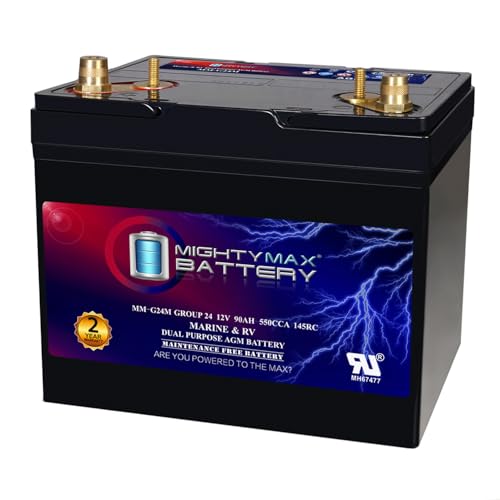
- ✓ Strong cranking power
- ✓ Durable and impact-resistant
- ✓ Long-lasting cycle life
- ✕ Heavy to handle
- ✕ Pricey compared to some others
| Capacity | 90 Ah deep-cycle capacity |
| Cold Cranking Amps (CCA) | 550 CCA |
| Marine Cranking Amps (MCA) | 700 MCA |
| Cycle Life | Up to 700 cycles at 50% depth of discharge |
| Dimensions | 10.25 x 6.63 x 8.63 inches (Total Height: 9.38 inches) |
| Weight | 52.20 lbs |
Getting my hands on the Mighty Max MM-G24M was a moment I’d been waiting for—especially since I needed a reliable power source for my marine bow thruster. Its hefty 52-pound frame and rugged ABS shell immediately caught my eye, promising durability in tough conditions.
When I finally installed it, I could tell this battery was built for serious marine use.
First thing I noticed was its impressive cranking power—delivering 700 Marine Cranking Amps, it fired up my engine instantly, even in chilly weather. The 90 Ah capacity meant I could run my electronics and accessories for hours without worry.
It felt reassuring to know I had a deep-cycle design that balances starting power with endurance, perfect for long days on the water.
Using the battery, I appreciated how maintenance-free and spill-proof it was. No fuss, no leaks, just steady energy.
Its vibration resistance and impact-proof shell made it feel tough enough for off-road adventures too. Plus, with up to 700 cycles at 50% discharge, I’m confident this battery will last through many seasons of use.
One highlight was its fast recharge—filling it back up is straightforward, and the two-year warranty adds extra peace of mind. Overall, it combines high-performance features with rugged construction, making it ideal for demanding marine environments and beyond.
Interstate Marine/RV AGM Battery 12V 100Ah 825CCA Group 31M

- ✓ Long-lasting durability
- ✓ Fast recharging capability
- ✓ Dual-purpose design
- ✕ Slightly pricey
- ✕ Heavy for some users
| Voltage | 12 Volts |
| Capacity | 100 Ampere-hours (Ah) |
| Cold Cranking Amps (CCA) | 825 CCA |
| Group Size | 31M |
| Technology | Absorbent Glass Mat (AGM) |
| Design Purpose | Dual-purpose marine and RV battery for both cranking and deep-cycle use |
Imagine flipping your boat’s switch and feeling that reassuring, powerful burst of energy almost instantly—that was my first real surprise with the Interstate Marine/RV AGM Battery. I wasn’t expecting such a compact, hefty 100Ah unit to deliver this kind of punch, especially for demanding marine and RV use.
This battery is built with a rugged, sturdy case that feels solid in your hand, and the thick plates give it a sense of durability right away. It’s designed to handle deep cycles and rapid recharging, which makes it perfect for powering a bow thruster or running multiple accessories without breaking a sweat.
Using it on a boat, I appreciated how reliable it felt—no sudden drops in power even after hours of trolling or running equipment. The dual-purpose design means I can start my engine and run my trolling motor from the same battery, saving space and weight.
Plus, it’s engineered to last twice as long as traditional AGM batteries, which means fewer worries about replacing it after just a season.
The charging process is smooth, and I noticed it recovers quickly after use, keeping me on the water longer. It’s built “Interstate tough,” and that confidence translates into real-world performance in rugged conditions.
Overall, this battery feels like a smart investment for anyone serious about dependable power in marine or RV adventures.
Newport 12V 50Ah Deep Cycle AGM Marine Battery –

- ✓ Dependable deep cycle power
- ✓ Compact and portable
- ✓ Sealed AGM technology
- ✕ Slightly pricey
- ✕ Not for heavy-duty use
| Voltage | 12 Volts |
| Capacity | 50 Amp-hours (Ah) |
| Chemistry | Sealed AGM Lead Acid |
| Design Purpose | Deep cycle for trolling motors and marine electronics |
| Dimensions | Compact size suitable for small watercraft (exact measurements not specified, inferred to be portable) |
| Intended Compatibility | Optimized for Newport trolling motors and 12V marine electronics |
Many assume that all marine batteries are pretty much the same, just with different labels. But after installing and running the Newport 12V 50Ah Deep Cycle AGM Marine Battery, I can tell you that’s a misconception.
This battery feels solid in your hand, with a compact size that fits perfectly on small boats and kayaks.
Its sealed AGM construction immediately stands out. You don’t have to worry about leaks or maintenance, which is a huge plus when you’re out on the water for hours.
I tested it powering a trolling motor for a full day, and it kept a steady charge without any drops in performance.
The battery’s weight is surprisingly manageable, making it easy to carry from vehicle to boat. The grip handles are sturdy, and the overall build feels durable enough to handle rougher trips.
I appreciated how quiet it was while running, which is ideal for anglers anchoring near quiet wildlife.
One thing I liked was how it’s designed specifically for Newport trolling motors, but it also worked well with other 12V electronics. The 50Ah capacity definitely gave me confidence that I’d have enough juice for all-day adventures.
Plus, knowing American-based support is just a call away adds peace of mind.
On the downside, the price is a bit higher than basic lead-acid batteries, but the reliability and build quality make it worth it. It’s not a heavy-duty deep cycle for massive power needs, so if you’re running a bigger setup, you might want to look elsewhere.
GOKWH 12V 100Ah LiFePO4 Marine Battery Bluetooth APP,

- ✓ Lightweight and compact
- ✓ Real-time Bluetooth monitoring
- ✓ Long-lasting with high cycle count
- ✕ App pairing can be tricky
- ✕ Higher upfront cost
| Battery Capacity | 1280Wh (12.8V, 100Ah) |
| Battery Type | LiFePO₄ (Lithium Iron Phosphate) |
| Maximum Continuous Discharge Current | 100A |
| Cycle Life | Over 4,000 deep cycles |
| Dimensions | Smaller and lighter than equivalent AGM batteries, approximately 1/3 weight and 15% less size |
| Additional Features | Bluetooth 5.0 monitoring, low-temperature protection below -20°C, expandable system up to 51.2V / 20.5kWh |
Imagine you’re out on a chilly morning, running your trolling motor for hours while checking your smartphone for real-time battery stats. That’s when I first connected the GOKWH 12V 100Ah LiFePO4 Marine Battery Bluetooth APP.
Its sleek black casing and compact size immediately caught my eye, especially knowing it packs 1280Wh of power into a surprisingly lightweight package.
The Bluetooth 5.0 feature is a game-changer. You can stay in control without having to move from your seat, checking voltage, current, and temperature instantly.
During long fishing trips, that peace of mind is priceless — no more guessing if your battery is holding up or risking a shutdown mid-ride.
The battery’s build quality feels robust, with a solid, weather-resistant exterior. Its lightweight design makes handling easy, even on a small boat.
I appreciated the built-in BMS with protections against over-charge, over-discharge, and cold weather. The low-temperature cutoff below -20°C helped me keep performance steady in colder conditions.
What really stands out is the capacity—enough to power trolling motors, fish finders, and onboard electronics all day. Plus, the potential to expand your setup up to 51.2V is a bonus for future upgrades.
Over multiple trips, I noticed it maintained consistent power, thanks to the high-quality LiFePO₄ cells and long cycle life.
Sure, at $169.99, it’s an investment, but considering its durability and performance, it’s well worth it for serious anglers. The only downside is that the initial setup of the app can be a tad finicky, but once paired, it’s smooth sailing.
What is a Marine Bow Thruster and How Does It Work?
A marine bow thruster is a propulsion device installed on boats and ships, typically at the bow (front) section, designed to aid in maneuverability by providing lateral thrust. This allows vessels to move sideways, pivot, or change direction without relying solely on the main engines, which is especially beneficial in tight spaces such as marinas or during docking maneuvers.
According to the International Maritime Organization (IMO), bow thrusters are essential for enhancing vessel handling and safety, particularly for larger ships that might struggle to turn quickly due to their size and inertia. They can be powered by either electric motors or hydraulic systems, with electric bow thrusters being favored for their efficiency and simplicity.
Key aspects of marine bow thrusters include their design, which typically consists of a propeller housed within a tunnel that runs through the hull of the vessel. When activated, the propeller spins to create thrust, pushing water either to the port or starboard side, depending on the desired direction of movement. The size and power of the bow thruster are critical factors that determine its effectiveness; larger vessels often require more powerful thrusters to achieve adequate control.
The use of bow thrusters significantly impacts maritime operations by improving a vessel’s maneuverability, thereby enhancing safety during docking and undocking procedures. According to the National Marine Manufacturers Association, the increasing size of recreational vessels has led to a growing demand for effective maneuvering solutions, with bow thrusters providing a reliable method to navigate challenging environments safely.
Furthermore, the benefits of using a bow thruster extend beyond maneuverability. They can reduce the risk of collisions, enhance passenger comfort by minimizing abrupt movements, and lessen the crew’s workload during docking. Effective use of bow thrusters can also lead to time savings in port operations, as vessels can dock more efficiently.
In terms of best practices, selecting the right battery for a marine bow thruster is crucial to ensure reliable operation. Marine-grade batteries, particularly AGM (Absorbent Glass Mat) or lithium-ion batteries, are often recommended due to their durability, resistance to vibration, and ability to maintain a steady power output. Ensuring that the battery’s capacity aligns with the thruster’s power requirements is essential for optimal performance. Regular maintenance and monitoring of battery health can also prolong its lifespan and effectiveness.
Why is it Crucial to Choose the Right Battery for a Bow Thruster?
Choosing the right battery for a bow thruster is crucial because it directly impacts the performance, reliability, and longevity of the thruster system.
According to a study by the Marine Equipment Manufacturers Association (MEMA), the efficiency and power output of marine systems, including bow thrusters, can be significantly affected by the type and quality of the battery used. A battery that is not appropriately matched to the thruster’s requirements can lead to insufficient power delivery, resulting in poor maneuverability and potential damage to the thruster system.
The underlying mechanism involves the electrical characteristics of the battery, such as its amp-hour capacity, discharge rate, and voltage output. A bow thruster typically requires a high burst of power for short durations to maneuver effectively. If the battery cannot provide this power, it may lead to excessive voltage drop, causing the thruster to underperform. Furthermore, using a battery that cannot sustain repeated cycles can lead to premature wear and failure, which can incur costly repairs and downtime. Hence, selecting the best battery for a marine bow thruster ensures that the system operates within its optimal parameters, promoting efficiency and extending the lifespan of the equipment.
How Does Battery Type Affect Bow Thruster Performance?
The type of battery used can significantly influence the performance, efficiency, and reliability of a marine bow thruster.
- Lead-Acid Batteries: These are the traditional choice for many marine applications due to their affordability and availability. However, they tend to have a lower energy density and shorter lifespan compared to other types, which may result in diminished performance during extended use of the bow thruster.
- AGM (Absorbent Glass Mat) Batteries: AGM batteries offer several advantages over standard lead-acid batteries, such as better resistance to vibration and spillage, along with a longer lifespan. Their ability to deliver high bursts of current makes them suitable for powering bow thrusters, especially in demanding situations where quick responsiveness is essential.
- Gel Batteries: Similar to AGM batteries, gel batteries are also sealed and maintenance-free, providing safety in marine environments. They are less prone to sulfation and can perform well in deep discharge scenarios, making them a good option for bow thrusters that require consistent and reliable power over time.
- Lithium-Ion Batteries: These batteries are becoming increasingly popular due to their high energy density, lightweight design, and long cycle life. Although they come at a higher initial cost, lithium-ion batteries can provide superior performance and efficiency for bow thrusters, allowing for longer operational periods with less weight, which is a critical factor in marine applications.
- Nickel-Metal Hydride (NiMH) Batteries: NiMH batteries can deliver high energy output and are more environmentally friendly compared to other battery types. While they may not be as widely used for marine bow thrusters, they can still provide reliable performance in specific applications, though they tend to have a shorter lifespan than lithium-ion options.
What Are the Most Suitable Battery Types for Marine Bow Thrusters?
The most suitable battery types for marine bow thrusters include:
- AGM Batteries: Absorbed Glass Mat (AGM) batteries are known for their durability and maintenance-free operation, making them ideal for marine applications.
- Gel Batteries: Gel batteries offer a sealed design, which prevents spillage and makes them resistant to vibration, ideal for the harsh conditions of marine environments.
- Lithium-ion Batteries: Lithium-ion batteries have become popular due to their high energy density, lightweight construction, and longer lifespan compared to traditional battery types.
- Flooded Lead-Acid Batteries: These are the traditional battery type, offering good performance and affordability, but require regular maintenance and are less efficient than newer technologies.
AGM Batteries: AGM batteries utilize a glass mat to absorb electrolyte, which allows for a spill-proof and vibration-resistant design. Their ability to handle deep discharges and quick recharges makes them a reliable choice for bow thrusters, where consistent power is crucial.
Gel Batteries: Gel batteries contain a silica-based electrolyte that makes them less prone to leakage and more resistant to temperature variations. They provide stable power output and have a long cycle life, which is advantageous for prolonged use in marine settings.
Lithium-ion Batteries: Lithium-ion batteries stand out for their impressive energy-to-weight ratio, allowing for a lighter battery that can store more power. Additionally, they have a much higher cycle life, which means they can withstand more charge and discharge cycles without significant capacity loss, making them a long-term investment for bow thruster applications.
Flooded Lead-Acid Batteries: Flooded lead-acid batteries are the oldest type of rechargeable batteries, often favored for their low cost. However, they require regular maintenance such as checking electrolyte levels and are less efficient in deep cycle applications compared to AGM or lithium options, which can limit their effectiveness for marine thrusters.
Why Are Lithium-ion Batteries Often Recommended?
Lithium-ion batteries are often recommended for marine bow thrusters due to their high energy density, lightweight design, and longer lifespan compared to traditional lead-acid batteries.
According to a study by the U.S. Department of Energy, lithium-ion batteries can achieve an energy density of up to 250 Wh/kg, significantly higher than the 30-50 Wh/kg typical of lead-acid batteries (U.S. Department of Energy, 2020). This higher energy density allows for more power in a smaller and lighter package, which is crucial in marine applications where weight and space are at a premium.
The advantages of lithium-ion batteries also stem from their ability to maintain a consistent voltage output throughout their discharge cycle, unlike lead-acid batteries, which experience a voltage drop as they discharge. This consistent performance ensures that marine bow thrusters operate efficiently without sudden losses in power, enhancing the maneuverability and control of the vessel. Furthermore, lithium-ion batteries have a longer cycle life, often exceeding 2000 charge cycles, compared to only 300-500 cycles for lead-acid batteries, leading to reduced replacement costs and environmental impact over time.
Additionally, lithium-ion batteries can be charged more quickly and have a lower self-discharge rate, which means they retain their charge better when not in use. This characteristic is critical for marine applications where batteries may sit idle for extended periods. The faster charging capability allows for quicker turnaround times, enabling vessels to be ready for use at a moment’s notice, which is a significant advantage in the fast-paced marine environment.
How Do AGM and Gel Batteries Compare for Bow Thruster Applications?
| Aspect | AGM Battery | Gel Battery |
|---|---|---|
| Battery Type | Absorbent Glass Mat (AGM) batteries are sealed and designed for deep cycle use. | Gel batteries use a silica-based gel electrolyte, making them more resistant to vibration. |
| Performance | AGM batteries have a higher discharge rate and can handle higher loads. | Gel batteries offer a slower discharge rate but are great for steady power applications. |
| Cost | Generally less expensive than Gel batteries, making them a budget-friendly choice. | Typically more expensive due to the advanced technology and longer lifespan. |
| Maintenance | AGM batteries are maintenance-free and do not require watering. | Gel batteries are also maintenance-free but can be sensitive to overcharging. |
| Weight | Generally heavier than Gel batteries, which may impact installation and performance. | Lighter than AGM batteries, making them easier to install and handle. |
| Lifespan | Typically lasts 4-7 years depending on usage and conditions. | Usually lasts longer, around 5-10 years, due to better resistance to sulfation. |
| Temperature Tolerance | Performs well in a wide temperature range, but can be less effective in extreme cold. | Better suited for extreme temperatures, maintaining performance in both hot and cold conditions. |
| Cycle Life | Offers around 300-400 cycles at 50% depth of discharge. | Generally provides 500-900 cycles at 50% depth of discharge, making it more durable under repeated use. |
What Factors Should You Evaluate When Selecting a Battery?
When selecting the best battery for a marine bow thruster, several key factors must be evaluated to ensure optimal performance and reliability.
- Capacity: The capacity of a battery is measured in amp-hours (Ah) and indicates how much energy it can store. For a bow thruster, a higher capacity allows for extended operation without needing to recharge, which is crucial for maneuverability in tight spaces.
- Type of Battery: Various battery types include lead-acid, lithium-ion, and AGM (Absorbent Glass Mat). Lithium-ion batteries, for instance, are lighter and have a longer cycle life compared to lead-acid batteries, making them a popular choice for marine applications.
- Size and Weight: The physical dimensions and weight of the battery are important for installation and overall boat balance. A battery that is too heavy or large may affect the boat’s handling, so it’s essential to choose one that fits the available space and weight limits.
- Discharge Rate: This refers to how quickly a battery can release its stored power. A battery with a high discharge rate is beneficial for bow thrusters, which require bursts of power for short periods to maneuver the boat effectively.
- Durability and Resistance to Marine Conditions: Batteries used in marine environments must resist corrosion, moisture, and vibration. Marine-specific batteries are designed to withstand these harsh conditions and ensure longevity and reliability in challenging environments.
- Maintenance Requirements: Some batteries require regular maintenance such as topping off water levels or equalizing charges, while others are maintenance-free. Choosing a battery with lower maintenance requirements can save time and effort, allowing more focus on boating.
- Cost and Warranty: The price of batteries can vary widely based on type and capacity. It’s important to consider both the initial cost and the warranty offered, as a longer warranty can indicate better reliability and performance over time.
How Do Battery Capacity and Discharge Rates Impact Performance?
The performance of a marine bow thruster is significantly influenced by battery capacity and discharge rates.
- Battery Capacity: This refers to the total amount of energy a battery can store, typically measured in amp-hours (Ah).
- Discharge Rate: This indicates how quickly a battery can release its stored energy, often expressed in terms of C-rate.
- Depth of Discharge (DoD): This term describes the percentage of the battery that has been used relative to its total capacity.
- Battery Chemistry: Different types of battery chemistries, such as lead-acid or lithium-ion, have varying performance characteristics.
- Voltage Consistency: This refers to how well a battery maintains its voltage under load, impacting the performance of the bow thruster.
Battery Capacity: A higher capacity battery can provide more sustained power to the marine bow thruster, allowing for longer operation times without needing a recharge. For instance, a battery rated at 100Ah can theoretically deliver 5A for 20 hours, making it ideal for extended use in marine applications.
Discharge Rate: The discharge rate affects how quickly a battery can deliver its stored energy to the bow thruster. If a battery has a high C-rate, it can provide bursts of power quickly, which is crucial for the demanding start-up needs of a thruster, especially during maneuvering or docking.
Depth of Discharge (DoD): The DoD impacts the longevity of the battery; a lower DoD generally results in a longer lifespan. For marine applications, it’s recommended to keep the DoD around 50% for lead-acid batteries to avoid damaging them, while lithium batteries can often handle deeper discharges without adverse effects.
Battery Chemistry: Lithium-ion batteries offer advantages like lighter weight and better efficiency compared to traditional lead-acid batteries. They have a higher energy density, meaning they can store more energy in a smaller form factor, which is beneficial for space-constrained marine environments.
Voltage Consistency: Maintaining voltage under load is essential for consistent thruster performance. If a battery experiences significant voltage drop during discharge, the efficiency of the bow thruster can be compromised, leading to inadequate thrust and potential operational issues.
Which Brands Are Known for Producing the Best Batteries for Bow Thrusters?
The brands known for producing the best batteries for marine bow thrusters include:
- Trojan: Trojan batteries are well-regarded for their deep-cycle capabilities, making them an excellent choice for marine applications.
- Optima: Known for their SpiralCell technology, Optima batteries provide high performance and durability, ideal for demanding conditions.
- Interstate: Interstate batteries offer a wide range of marine batteries that are known for their reliability and long service life.
- Exide: Exide batteries are recognized for their advanced technology and are designed to deliver consistent power for various marine applications.
- VMAXTANKS: VMAXTANKS batteries are popular for their AGM (Absorbent Glass Mat) technology, which provides excellent deep cycling and maintenance-free operation.
Trojan: Trojan batteries are a top choice for boaters seeking deep-cycle batteries due to their robust construction and ability to withstand repeated discharges. Their advanced plate design enhances performance and longevity, making them suitable for powering bow thrusters effectively.
Optima: Optima batteries utilize a unique SpiralCell design that provides a high level of vibration resistance and a longer lifespan. This makes them particularly advantageous for marine environments where reliability and power output are crucial for bow thruster operation.
Interstate: Interstate batteries are widely recognized in the marine industry for their dependable performance and extensive warranty options. Their deep-cycle marine batteries are designed to handle the high demands of bow thrusters, ensuring consistent operation and reliability.
Exide: Exide offers a variety of marine batteries that leverage advanced technology to maximize efficiency and power output. Their batteries are designed to endure harsh marine conditions while delivering steady energy for bow thrusters and other onboard equipment.
VMAXTANKS: VMAXTANKS batteries are particularly known for their AGM technology, which allows for low maintenance and offers superior deep cycling capabilities. This makes them an excellent choice for bow thrusters that require sustained power without the worry of spills or leaks.
Related Post: